

If you’ve heard the term “battery wall” and pictured a giant battery hanging in your garage, you’re not entirely wrong, but today’s battery systems are a little more sophisticated than that.
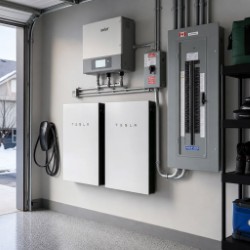
For homeowners looking for backup power, greater control over their energy use, or a way to make better use of their solar investment, a home battery can be an increasingly useful addition to the house.
A home battery, sometimes called a “battery wall,” is a large rechargeable battery designed to store electricity for later use. It can be paired with solar panels or installed without solar and charged directly from the utility grid.
Most modern residential systems use lithium-based battery cells packaged inside a protective enclosure along with sophisticated electronics that control charging, discharging, temperature, and safety. Depending on the product, the system may also incorporate an inverter that converts electricity between the power used by solar panels and the AC power used in your home.
“The important thing for homeowners to understand is that today’s home batteries are much more than simply a big battery hanging on the wall,” Kyle Ritland of Sun Valley Solar said. “They’re intelligent energy-management systems that can decide when to store energy and when to release it based on utility rates, solar production, household consumption and whether the grid is available.”
Different sizes for different uses
If you start shopping for a home battery, you’ll come across numbers such as 5 kWh or 13.5 kWh. While that terminology sounds intimidating, the idea is simple. Ritland said that there’s a pretty wide range, both in the physical size of the equipment and in how much energy it can store.
Battery capacity is typically measured in kilowatt-hours (kWh), while its power output is measured in kilowatts (kW). Capacity tells us roughly how much energy is stored in the battery – think of it like the size of a gas tank – while power tells us how much electricity the battery can deliver (think like the size of a hose).
“For some real-world perspective, a Tesla Powerwall 3 stores 13.5 kWh of energy and measures about 43.5 inches tall, 24 inches wide and 7.6 inches deep. It weighs over 280 pounds. Despite looking relatively compact on the wall, that’s a substantial piece of equipment,” Ritland said.
Other manufacturers take a more modular approach. An Enphase IQ Battery 5P, for example, stores 5 kWh and measures approximately 38.6 inches tall, 21.7 inches wide and 7.4 inches deep, with an installed weight of about 174 pounds.
Because each Enphase battery has a smaller capacity, multiple units are generally combined into a single system. Two units provide 10 kWh of storage, three provide 15 kWh, and so on. By comparison, additional Powerwall 3 expansion units add another 13.5 kWh each.
“That’s a good illustration of why homeowners shouldn’t judge batteries by physical dimensions alone. A Powerwall 3 isn’t dramatically larger on the wall than a single Enphase 5P, but it contains nearly three times the energy capacity and is also considerably heavier.”
More importantly, there’s no one-size-fits-all battery. Every home has a different electrical system, and every homeowner has unique goals, priorities, and budgets. Proper battery sizing involves much more than a home’s square footage.
“We look at how much electricity a homeowner uses and when, their utility and rate plan, whether they have solar, and what they want the battery to accomplish. Backup power, peak-rate savings, and maximizing the use of your own solar energy can all require different battery designs,” Ritland said.
The goal is to install enough storage and power to meet what the homeowner actually needs, without paying for capacity they are unlikely to use.
In terms of safety…
Modern home batteries are designed with layers of protection, including systems that continuously monitor voltage, temperature, and operating conditions. Trustworthy products are also tested to rigorous safety standards.
You’re storing a large amount of energy in a relatively small space, so proper installation matters tremendously. Ritland mentioned that batteries must be installed according to manufacturer specifications and applicable electrical, building, and fire codes: location, clearances, mounting, electrical protection, and protection from physical damage all matter.
“There can also be additional safety requirements established locally, by cities, utilities, and other authorities having jurisdiction (AHJ). Depending on where and how the battery is installed, an AHJ may require a specific type of heat detection system, particularly for garage or indoor installations,” Ritland said. “These requirements can vary from location, which is another reason that a quality installer is key, preferably one with intimate local knowledge.”
He encourages homeowners to think about battery safety like they would their home’s electrical service panel. Properly designed, permitted and professionally installed equipment should quietly do its job in the background. One appealing feature of modern home batteries is that they generally don’t require much hands-on maintenance.
For example, Tesla specifies no scheduled preventive maintenance for Powerwall 3. Homeowners should keep the area around the battery clean and unobstructed so airflow isn’t restricted, and check the system periodically to make sure it’s operating normally.
Regularly checking system monitoring can help homeowners or their service provider identify issues or faults that could otherwise go unnoticed. Home battery systems typically include monitoring capabilities through an app or on the web.
Location, location, location
When installing a battery, there isn’t one universally “best” location. Ritland and his team generally look for a spot close to the home’s electrical panel or necessary connection point and, when possible, inside a garage to reduce environmental exposure.
The setup depends on the home, equipment, manufacturer requirements, and local code. The team has to account for required clearances, ventilation, protection from physical damage, service access, and the equipment’s weight.
Many modern batteries are rated for indoor or outdoor installation. Powerwall 3, for example, can operate from -4°F to 122°F, although Ritland said Tesla explained that “that performance can be reduced in temperatures above 104°F.” That’s an important consideration, especially in Arizona.

“Direct sun exposure – particularly on a west-facing wall – ambient temperature, weather exposure, proximity to electrical equipment, along with accessibility can affect where the battery goes. Whenever possible, protecting a battery from Arizona’s environmental extremes can help provide a better operating environment for the equipment,” Ritland said.
The right system depends on how a home uses electricity, whether it has solar, what the homeowner wants the battery to do, and where the equipment can safely be installed. With the right sizing, location and installation, a battery can become a relatively inconspicuous part of a home’s energy system. Learn more at Sun Valley Solar.
###
Homeowner Handbook | #BatteryWalls
PODCAST
PHOTO CREDIT
- Sun Valley Solar