

It will rain again; we are pretty sure and hopeful for that free water from the sky. When it does rain that water works its way into our washes and rivers but not before its journey begins in your yard.
Landscape Drainage Can Present Challenges
Landscape drainage can present challenges in how the water can be utilized or directed where it needs to go.
We reached out to Rosie Certified Partner Chris Wellborn of Vincente Landscaping in the mountain town of Prescott. With all its hills and valleys Chris has seen and worked with just about every possible drainage challenge one might think of. We wanted to relay some of his experience to y’all before our summer rains land in your yard.
Legal Considerations
Check Your Municipality and HOA for Rules That Apply to Your Home.
Before we begin with tips and solutions, a quick review of Arizona and local restrictions is in order.
In some areas of Arizona, typically with individual custom home lots, water that flows through or lands on your property must exit the property the way it has prior to being developed.
Mass graded subdivisions, where the home developers have created new surface conditions, will have a subdivision mass drainage plan in place with the local jurisdiction and the water from your property is handled on a subdivision wide scale.
In other areas you cannot have water from your property trespass onto your neighbor’s property. You need to verify the rules that apply in your jurisdiction with your HOA or municipality.
Good Neighbor Considerations
Seemingly inconsequential changes to surface drainage can be surprisingly disruptive to everyone downstream. Don’t be that neighbor who ignores the law of physics. We have seen these things create havoc on downhill neighbors: holes poked in the bottom of a block wall, grading a new driveway, and even planting a raised garden bed.
Even in subdivisions that you may think are on flat ground, (by the way there are none of those) you need to consider the surface drainage impact in your every decision to retain your title as a good neighbor.
Note: *Monsoon season will often reveal any drainage issues your property has. A ¼” of rain generates 1700 gallons of water on a ¼ acre lot. If that comes down slow onto dry thirsty soil, probably no concern. That same ¼” comes down in 30 minutes onto monsoon moistened soil, you will have a concern.
Ways To Work With Drainage
When rain lands on our property it can be addressed several ways.
Capture It
Chris tells us there are several ways to capture rainwater.
- Shape the ground in your yard to collect runoff in a surface pond. This is known as passive rainwater harvesting.
- Install a concrete surface cistern. Having the water collected in a concrete cistern stops the water from percolating into the ground. Some folks install a sump pump into the cistern to utilize the captured water for irrigation.
- Plastic containers below grade cisterns. This type of capture prevents both percolation and evaporation.
Redirect It On Our Property

The last thing we want is water in our home. There are several ways to redirect water away from the house. The goal is getting the water to the street or a main drainage course, either naturally or with man-made methods.
- If your home is lower than the street you will need to redirect water around the house to a drainage course below. There are several methods:
- French Drain. This drain is a perforated pipe buried adjacent to your homes foundation at about footing depth. The pipe collects water through the perforations and directs it away. This pipe is designed to come out of the ground at a point lower than your home and directs water to the main drainage course.
- Trench Drains. These drains are manufactured troughs that you might find embedded in a driveway or walkway in front of a door to prevent water from entering the home at the door opening. These troughs have a grate or a slotted cover level with the surface of the drive or walkway. The water is collected and redirected to a main drainage channel.
- If your home is higher than the street: when the hillside extends above your property, close to your home, you may need to employ a combination of tactics.
- Swales, rivulets, retainage basins, french basins and water proofing your stem wall are all viable options.
- Flat lots and areas also can present some challenges. While drainage systems may be designed to direct flow, the flatter the slower it will be to drain. This is a challenge when we get those downpours Arizona is so famous for. The need to accommodate standing water is typically handled by land manipulation creating the surface pond we talked about earlier.
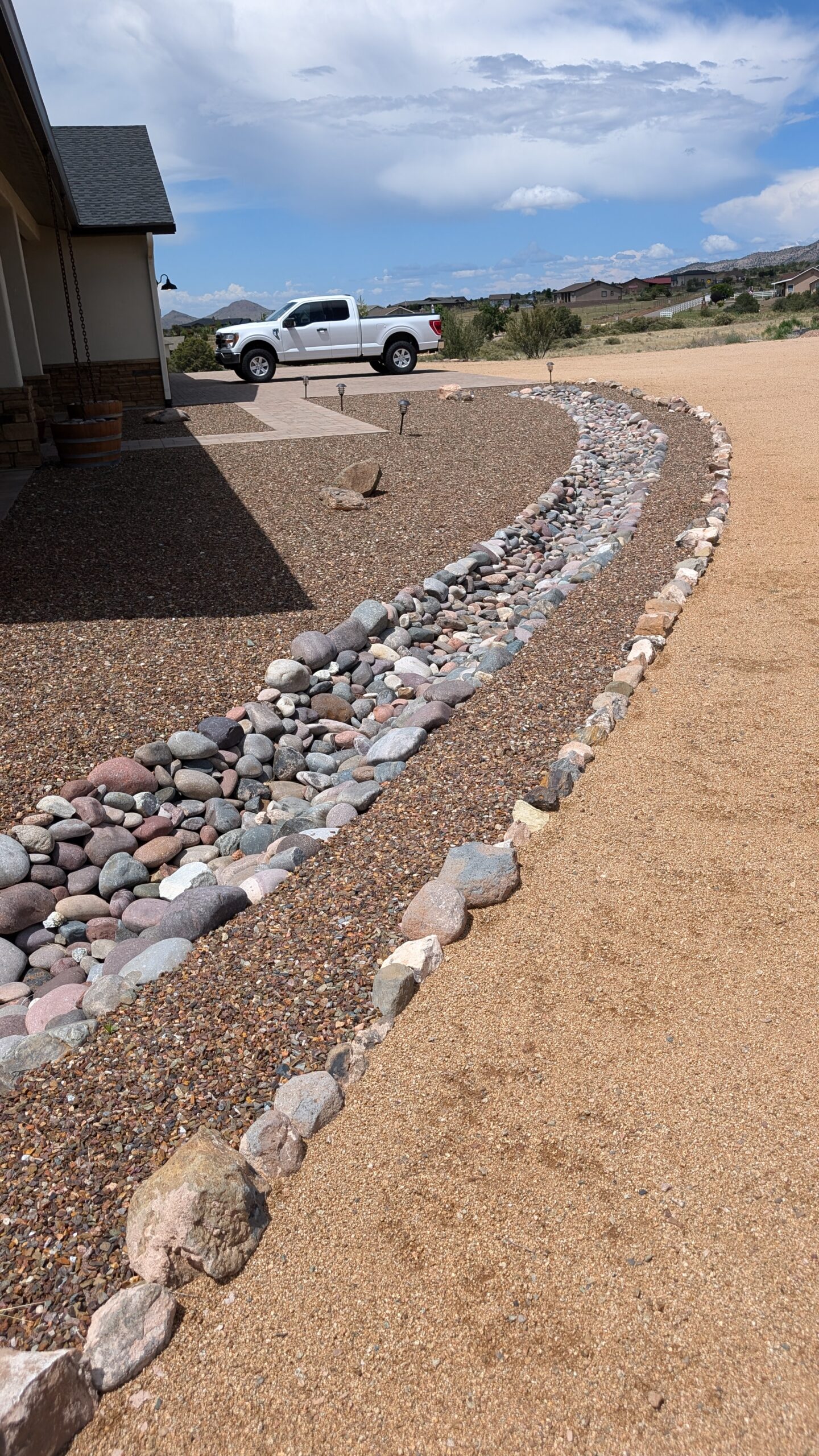
Example of a swale, an excellent way to eliminate erosion
Erosion Control
When the home is on a sloping lot, erosion control in the landscaping becomes important. The primary way to control erosion is to slow the water flow down and prevent the dirt from washing away. Here are some methods to control erosion.
- Rip Rap – Typically consisting of 3” to 5” rocks that line the drainage channels created on your property. This not only slows down speed of the water by being little obstacles.
- Sheet Drainage – Decorative gravel. A mainstay in a xeriscape yard, decorative, colored gravel works to deter erosion from ‘sheet drainage’. Sheet drainage is what the water flow is called as it flows across across the sloping yard to the drainage channel. The gravel surface works to slow down the water preventing the dirt from flowing away with the water.
- Planting or Artificial Ground Cover – Planting includes grass (like hydro-seeding), artificial turf and ground cover plantings such as myrtle and ground cover juniper.
Check with your local Rosie Certified Partner landscaping company to see what works best. These will slow the water down and keep the drainage courses from filling up with dirt runoff.
On site drainage is important. Consider there are a lot of homes out there. Millions really. If we don’t individually take precautionary measures to deal with water at home, the impacts on our major systems is huge. Of particular concern is the filling up or ‘silting in’ of our major drainage systems from dirt runoff due to erosion. By slowing down water on our property we help the larger systems as they sometimes struggle with major storm runoff.
We have seen a lot of creative solutions across Arizona by some very clever people. We would love for you to share a photo with us of those creative projects in your area. Please send them to info@rosieonthehouse.com
###
Homeowner Handbook | #LandscapeDrainage
PODCAST
May 17, 2025
Our Weekly To Do on landscape drainage. It can present challenges on where water needs to flow as to not impede on a home’s foundation or neighboring properties. Plus explaining what the term ‘100 Year Flood’ really means about potential flooding in your area. And homeowner questions on insulation, air conditioning units and more!
Original Broadcast Archive Page With Expanded Content
PHOTO CREDIT
- Vicente Landscaping, Prescott, AZ