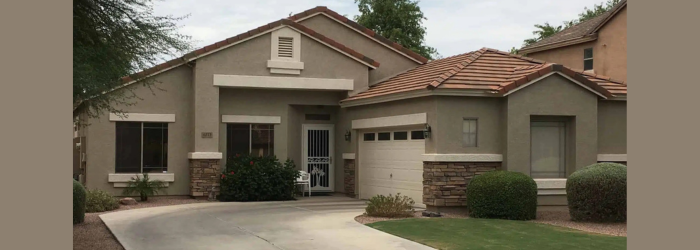

When most homeowners think about painting, they picture fresh walls, new colors, and that satisfying “out with the old, in with the new” feeling. According to Mike Stutte of Smith Painting & Services, a Rosie on the House Certified Partner, there’s more going on – especially here in Arizona.
“It is my goal to educate the homeowner on what they might not know and what to expect,” Stutte said. If you live in Arizona, that education often starts outside.
Something we all know: Arizona sun is no joke
Interior paint provides a refresh, but exterior paint is essential protection for your biggest investment: your home. During estimates, Stutte will often rub the sun-beaten south and west walls and show homeowners the chalky, powdery residue – evidence of paint breakdown – on his hand.
This residue indicates that the protection of your home’s exterior has been compromised. “You’re just leaving it completely wide open to the elements,” says Stutte – there is no protection left.

In Arizona, flat exterior paint lasts five or six years at best. After that, the binder – the rosin holding pigment together – breaks down. Our weather isn’t easy on homes. There’s triple-digit heat, freeze warnings, and monsoons that practically sandblast stucco.
The exterior is the most critical paint for any homeowner in Arizona. The average lifespan of a well-done exterior paint job is about 10 years. Putting off exterior painting often leads to bigger repair bills later. “Once you start having to tack on repairs, that’s when your budget goes through the roof“, says Stutte.
It’s not just spray and walk away
A quality exterior paint job is a process. The first step is always to pressure wash the surface. After that, repairs are made, but stucco cracks and larger repairs require different techniques. Small cracks are typically handled with a simple brush-in/brush-out method. Larger repairs involve more steps: first, clean the area, apply a sealant, cover the repair with fresh stucco, and then prime the entire repaired section.
Stutte’s team fully primes the home before applying two coats of paint. And then comes a step many homeowners don’t realize is essential: backrolling, which means rolling paint into the surface after spraying to improve coverage.
Arizona stucco is thick and textured. Spraying alone won’t fully penetrate the surface. Backrolling pushes paint into the high and low areas, improving adhesion and helping the finish last longer.
“Spraying is one thing, but putting it on with a roller after it’s been sprayed, that’s the ticket,” Stutte said.
And if you’re wondering whether summer is off-limits for exterior projects – it’s not. “And here’s a surprising fact: we can paint all year round here.”
Modern paint products can be applied to surfaces up to 120 degrees Fahrenheit. Crews simply adjust their schedules, often starting as early as 5 a.m. during peak summer months to beat the worst of the heat.
For many homeowners, the biggest hesitation is the convenience factor. Interior projects may slow down in August when families are coming home from traveling or getting ready for back-to-school. But exterior painting is fair game year-round.
Prep first, paint second
Once the outside is protected, attention often turns to the inside. Just like exterior work, interior painting starts with preparation. Whether it’s a single bedroom or a full refresh, timing depends on the scope of work. After the proposal is finalized, the Smith Painting team creates a phased plan, often beginning with bedrooms and hallways.
Next, floors are covered with plastic and tarps, windows are taped off, and drywall repairs are completed before any paint goes on. The first stage usually focuses on woodwork. Then comes the first coat. After it dries, the crew returns for the second coat. A typical phase may take 1 to 2 days, depending on the furniture and accessibility.
“We ask that the homeowners move all their breakables; things that can’t be replaced,” Stutte said. “That’s their homework!”
Larger pieces may still need to be moved by the crew, but clear communication during the pre-walk helps everyone stay on the same page.
Let’s talk primer (and why white isn’t just white)
Primer isn’t required for every interior job, but it’s sometimes non-negotiable, says Stutte. High-quality paint can often go directly over existing walls. But new drywall and major repairs need primer. Bold or dark colors may require additional coats.

When you’re dealing with really dark navy blue, reds, oranges, and even some yellows, a good painter will often put on an extra coat to get the true color.
And then there’s white – there are hundreds of versions. Stuttes’ least favorite? Reflective white.
“It is exactly what it sounds like. It’s very translucent. It’s very non-coat friendly. So it takes it sometimes up to five coats to get that color to adhere, because there’s no body to it,” he said.
More coats mean more time and more material, sometimes increasing cost by 15 to 20 percent. That’s why having clear expectations upfront matters.
The finish matters more than you think
Color gets all the attention, but sheen plays a huge role in durability and day-to-day life.
There are three standard sheens used most commonly in the industry: flat for ceilings, eggshell or satin for walls, and, most of the time, semi-gloss for woodwork.
Semi-gloss stands up well on doors and trim. Eggshell offers washability for busy households.
“If you’ve got kids or grandkids, you want to be able to clean your walls without having to paint them all the time,” Stutte said. And beyond durability, there’s mood.
“If you walk into a room and you’re like, ‘I don’t like this color anymore,’” Stutte said, “It kind of affects your mood.”
Fresh paint can make a home feel lighter, calmer, and simply more enjoyable to live in. Inside or out, it’s more than just color on a wall – it’s protection, preparation, and peace of mind.
A quality paint job isn’t something you should need to redo every few years.When done properly, it protects your home and extends the life of siding, stucco, and trim. You might live in a home for 18 or 20 years without touching the interior if you love your colors. Exterior paint, however, is on the front lines, absorbing sun, wind, sand, and storms.
For Stutte, it always comes back to education. When homeowners understand the process, from prep work to primer, from sheen selection to backrolling, they’re empowered to make decisions that protect their homes, their budgets, and their peace of mind.
And in Arizona, that layer of protection might just be the most important one your house has.
###
CONTENT PARTNER | SMITH PAINTING & SERVICES

Smith Painting and Services is Family Owned and Operated dedicated to delivering high quality service. Smith Painting has been leading the painting industry in the Phoenix, Arizona area since 1947. Over the last 60 years we have been careful to maintain the attributes that have made Smith Painting successful; Personnel Supervision, the use of top-of-the-line paint products, and customer satisfaction.
PODCAST
PHOTO CREDIT
- Smith Painting & Services